Introduction: The Problem Is Bigger Than Lead Management
Real estate businesses do not struggle only because they lack leads. They struggle because managing those leads, the people responsible for them, the sales process, and the information needed to make decisions becomes increasingly complex as the business grows.
A brokerage may generate hundreds of inquiries, manage multiple projects, employ dozens of sales representatives, work with channel partners, coordinate site visits, and communicate with prospects across different channels.
Yet the information required to manage the business is often scattered across spreadsheets, messaging applications, standalone CRM systems, reporting tools, and manual processes. The result is an operational gap.
Leads exist, but follow-ups are missed. Salespeople are active, but management lacks complete visibility. Reports show activity, but do not always explain what needs attention. Software stores information, but business owners still have to connect the dots themselves.
This is why the next evolution of real estate technology must go beyond conventional CRM software.
Real estate businesses need a Sales Operating System: a connected platform that helps organize sales operations, coordinate teams, understand opportunities, and turn business data into actionable intelligence.
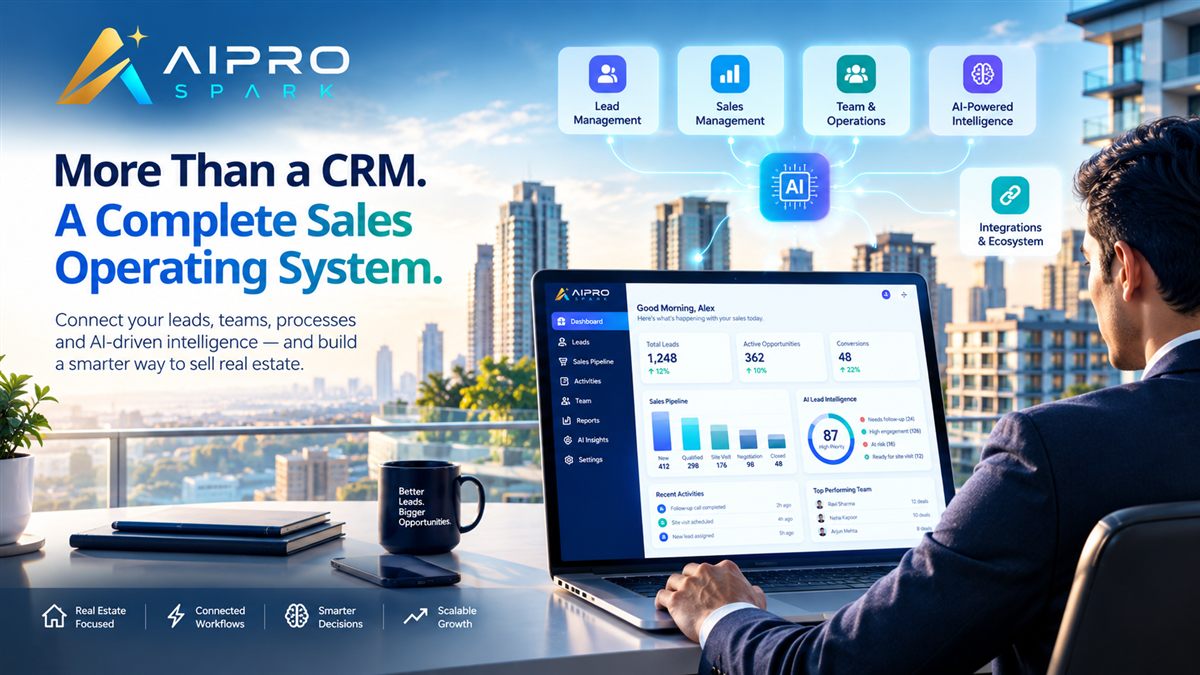
This is the direction AIProSpark is built around. Rather than approaching CRM as an isolated application, AIProSpark takes a broader view of how real estate businesses operate, sell, manage their teams, and grow.
1. The Evolution of Real Estate Technology: From CRM to Sales Operating System
Business software has evolved through several stages.
Stage 1: Digital Record-Keeping
Early CRM systems helped businesses replace paper records and spreadsheets with centralized customer databases. They answered a fundamental question: What information do we have about our customers?
Stage 2: Sales Process Management
Modern CRM platforms introduced lead pipelines, activity tracking, task management, reminders, and sales reporting. They helped businesses answer: Where are our opportunities, and what is happening with them?
Stage 3: Automation and Integration
Businesses began connecting communication channels, marketing platforms, and operational applications to reduce manual work and information silos. The question became: How can our systems work together?
Stage 4: AI-Driven Sales Operations
The next stage combines connected business data, operational workflows, and AI-assisted analysis. The objective is to help businesses understand not only what happened, but also which opportunities need attention, where processes may be breaking down, and what actions deserve priority.
This is the broader category in which AIProSpark positions itself: a Real Estate Sales Operating System designed to connect the operational side of selling with a more intelligent approach to sales management. A CRM is one important component of the sales process. A Sales Operating System takes a wider view of the business processes surrounding it.
2. What Is a Real Estate Sales Operating System?
A Real Estate Sales Operating System is a connected environment for managing the activities, people, processes, and intelligence involved in selling property. It brings the sales lifecycle into a structured framework instead of treating each activity as a separate task or application.
For a real estate brokerage, this can include:
- •Lead operations: Capturing, organizing, assigning, and tracking inquiries.
- •Sales management: Managing pipelines, opportunities, sales stages, and follow-up activities.
- •Team operations: Coordinating responsibilities and monitoring team performance.
- •Business intelligence: Converting operational data into meaningful insights.
- •AI-assisted decision support: Helping teams interpret lead engagement, qualification gaps, and potential conversion risks.
- •Connected workflows: Enabling information to move between supported business applications and communication systems.
The value comes from the relationship between these components. Identifying a promising lead is useful. Connecting that insight to the assigned salesperson, next follow-up, opportunity stage, and manager’s view of the pipeline makes it operationally meaningful. The goal is not simply to give businesses more software. It is to establish a more consistent way of working.
3. AIProSpark: Built Around the Real Estate Sales Lifecycle
AIProSpark is positioned as a Sales Operating System for real estate businesses that want to move beyond disconnected tools and fragmented sales processes. Its approach centers on bringing customer management, sales workflows, operational visibility, and AI-assisted intelligence into a more connected environment.
A. Lead Management and Customer Relationships
Every sales opportunity begins with information about a prospective customer. AIProSpark’s CRM foundation helps businesses organize lead records and manage their progression through the sales process. A structured lead management workflow can support:
- •Centralized lead records.
- •Lead assignment and ownership.
- •Sales-stage tracking.
- •Customer interaction history.
- •Follow-up activities and pending actions.
- •Visibility into active and inactive opportunities.
This creates a consistent operational record that sales representatives and managers can use to coordinate their work.
B. Sales Pipeline and Opportunity Management
Generating an inquiry is only the beginning. Businesses must understand how opportunities progress from initial contact toward qualification, property discussions, site visits, negotiation, and conversion. Sales pipeline management provides a framework for tracking that progression.
With a structured pipeline, managers can identify stalled opportunities, review activity across stages, and understand where additional attention may be required. Instead of depending entirely on verbal updates or manually compiled spreadsheets, teams can work from a more consistent view of sales activity.
C. Team and Business Operations
Sales performance is influenced by more than individual sales representatives. Responsibilities, team coordination, operational discipline, and management visibility all contribute to the outcome. AIProSpark’s broader Sales Operating System vision extends beyond customer records toward connected team and operational workflows, including HRMS and payroll capabilities within the wider platform offering. The exact workflows available depend on the enabled modules and subscription.
D. AI-Driven Lead Intelligence
Traditional reporting explains activity. AI-assisted intelligence aims to help interpret that activity. AIProSpark’s AI Doctor intelligence layer is designed to support a more analytical approach to lead assessment and sales decision-making. Depending on the available data and configured capabilities, lead intelligence can consider factors such as:
- •Customer engagement and interaction patterns.
- •Recency of communication.
- •Quality of recorded remarks.
- •Lead source and qualification information.
- •Budget and financing considerations.
- •Current sales stage and unresolved objections.
- •Missing information that may affect the next sales decision.
The objective is to help teams understand a lead beyond a name, phone number, or pipeline status. A lead with frequent interactions may still have a significant budget concern. Another lead may appear inactive because a critical follow-up has been missed. A third may require additional qualification before the salesperson can determine the appropriate next step.
The strategic shift is from simply tracking leads to developing a more informed understanding of sales opportunities.
4. AI Should Help Businesses Decide What to Do Next
One of the biggest limitations of conventional sales management is the gap between information and action. A dashboard may show hundreds of leads. A report may reveal that conversions have declined. But the sales manager still needs to determine where to focus attention. A more intelligent sales workflow aims to shorten that gap.
Consider a brokerage managing 1,000 active leads across multiple sales representatives. The traditional approach may rely on manual review, individual judgment, and daily reporting. An AI-assisted approach can help organize the available evidence into more useful questions:
- •Which leads have not received a timely follow-up?
- •Which prospects have demonstrated recent engagement?
- •Which opportunities have unresolved objections?
- •Which leads require additional qualification?
- •Which sales stages appear to be experiencing delays?
- •Which activities should a manager review first?
AI does not eliminate the need for sales judgment, nor can it guarantee that a prospect will convert. Its purpose is to help teams use available information more consistently and direct attention toward the opportunities that warrant it. For real estate businesses, this can be a meaningful improvement over treating every lead as an equally urgent task.
5. The Complete Sales Lifecycle: Connecting Every Stage
A scalable sales operation requires continuity from the first inquiry through the final outcome. The AIProSpark sales operations framework is a conceptual view of how connected sales workflows can operate:
- Lead Generation and Capture — organize inquiries and customer records.
- Lead Assignment and Qualification — establish ownership, requirements, and priorities.
- AI-Assisted Lead Intelligence — interpret engagement, gaps, and potential risks.
- Follow-Ups and Sales Activities — coordinate communication and next actions.
- Pipeline Review and Conversion — track progress and evaluate sales outcomes.
- Continuous Improvement — use outcomes and operational data to refine processes over time.
This framework illustrates the operating model behind an integrated sales platform. Actual automation and integrations depend on the features enabled in the implementation. The essential principle is continuity: information gathered at one stage should help inform the next stage rather than becoming isolated in a separate tool or manual report.
6. Why Real Estate Brokers Need Operational Visibility, Not Just Reports
As a real estate brokerage expands, management complexity increases. A business owner may need to understand the performance of individual sales representatives, different property projects, lead sources, and sales stages at the same time. A meaningful operating view should help answer three categories of questions.
- •Activity: What is the team doing? How many leads are being contacted, and which follow-ups remain pending?
- •Progress: What is happening to the opportunities? How many are progressing, stalling, or moving toward negotiation?
- •Outcomes: Which activities and sources are associated with qualified opportunities and actual conversions?
When these dimensions can be evaluated together, management has a stronger foundation for identifying process gaps. A large number of inquiries may appear positive until the business discovers that few are being qualified. A high volume of calls may look productive until managers realize that opportunities are not progressing to site visits. The purpose of a Sales Operating System is to support a more complete view of the business, connecting day-to-day activity with pipeline progression and commercial outcomes.
7. A Connected Platform Instead of a Collection of Disconnected Tools
Many growing businesses gradually accumulate separate applications for customer management, communication, employee operations, reporting, and automation. Each application may solve an individual problem, but the overall workflow can remain fragmented.
This creates operational costs that are not always immediately visible: duplicated data entry, inconsistent records, repeated reporting work, and delays in sharing information between teams.
AIProSpark’s broader platform direction is to bring relevant sales and business workflows into a more connected operating environment. Its ecosystem vision includes CRM, sales management, team operations, AI-assisted intelligence, and integration capabilities that can connect supported systems. An integration layer such as AegisConnect can form part of this wider architecture by enabling supported applications and services to exchange information through APIs, events, and webhooks.
The objective is to allow businesses to develop a connected operational environment while retaining the flexibility to integrate with other systems where required. A business platform should not become another isolated application. It should help reduce fragmentation across the systems that support the business.
8. Who Should Consider a Real Estate Sales Operating System?
An integrated sales operating model can be particularly valuable for:
- •Real Estate Brokers and Brokerages — managing high inquiry volumes, multiple sales representatives, and ongoing customer follow-ups.
- •Property Consultants and Sales Teams — who need consistent lead records, clear ownership, and better visibility into opportunities.
- •Multi-Project Real Estate Businesses — managing several developments or property inventories with different sales processes and reporting needs.
- •Channel Partner Networks — coordinating lead referrals, sales activity, and opportunity tracking across a broader partner ecosystem, where the relevant workflows are configured.
- •Growing Real Estate Enterprises — that want to establish consistent operating processes before increasing team size, project count, or lead volume.
The value of the platform is not limited to business size. It depends on how much coordination, process discipline, and visibility the business needs.
9. How to Evaluate a Sales Operating System
Choosing a platform should begin with the business’s operating requirements rather than a checklist of features. Before selecting a solution, decision-makers should evaluate:
- Sales workflow coverage: Does the platform support the actual stages and responsibilities of the sales process?
- Data quality: Can the organization maintain reliable customer records and interaction histories?
- Operational visibility: Can managers evaluate team activity, opportunity progression, and outcomes?
- AI transparency: Are AI-generated assessments understandable, appropriately qualified, and supported by available data?
- Integration flexibility: Can the platform exchange information with relevant business applications?
- Scalability: Can workflows and reporting accommodate growth in users, projects, and lead volumes?
- Adoption and accountability: Can the team use the system consistently, with clear ownership of tasks and records?
AI should not be evaluated solely by the presence of a chatbot or a numerical lead score. Its business value depends on whether it supports better decisions within the actual sales workflow. Similarly, a large feature list is not enough if the platform does not help the business operate more consistently. The most useful system is one that connects information, responsibilities, and decisions into a coherent working process.
10. The Future of Real Estate Sales Is Connected and Intelligence-Driven
The next phase of real estate technology will involve more than digitizing existing processes. As business data becomes more structured and systems become better connected, AI can increasingly support lead assessment, process analysis, and sales prioritization.
Communication and workflow automation can reduce repetitive work. Integrated operational data can improve management visibility. AI-assisted insights can help sales teams focus their attention more effectively. However, these benefits depend on reliable data, thoughtful implementation, appropriate human oversight, and workflows that reflect the realities of real estate sales.
The long-term opportunity is to build systems that help businesses move from reactive management toward more structured, data-informed operations. That is the larger opportunity behind the Sales Operating System category.
Conclusion: AIProSpark Is Built for the Next Stage of Real Estate Sales
The real estate industry does not need another isolated tool that records customer information while leaving the rest of the business fragmented. It needs a more connected approach to managing sales: one that brings together leads, people, workflows, operational data, and intelligence.
AIProSpark is positioned around this vision as a Real Estate Sales Operating System — extending beyond traditional CRM toward a broader model of connected sales operations and AI-assisted decision-making. By combining CRM-focused workflows with sales management, wider operational capabilities, and AI-driven lead intelligence, the platform aims to help real estate businesses build more organized, visible, and scalable sales processes.
AIProSpark — Beyond CRM. Built for Real Estate Sales Operations.
Frequently Asked Questions
What is a Real Estate Sales Operating System?
A Real Estate Sales Operating System is a connected platform for managing lead relationships, sales pipelines, follow-ups, team workflows, and business intelligence. It takes a broader operational view than a conventional CRM.
How is a Sales Operating System different from a CRM?
A CRM primarily organizes customer information and relationship workflows. A Sales Operating System extends the concept by connecting CRM with sales execution, operational processes, reporting, integrations, and AI-assisted decision support.
What is AIProSpark?
AIProSpark is a real estate-focused Sales Operating System designed to bring customer relationship management, sales operations, and AI-assisted sales intelligence into a connected platform.
How can AI help real estate sales teams?
AI can help teams interpret available lead information, identify engagement patterns, surface missing qualification details, and prioritize opportunities for review. Its effectiveness depends on data quality and the capabilities implemented in the system.
Can AIProSpark support growing real estate businesses?
AIProSpark's platform direction is designed around more organized and connected sales operations. Businesses should evaluate the available plans, modules, integrations, and workflows against their specific operational requirements.
Why is sales intelligence important in real estate?
Sales intelligence helps businesses interpret operational data rather than relying exclusively on activity counts. It can support better visibility into engagement, qualification, pipeline progression, and potential process bottlenecks.
How can I learn more about AIProSpark?
Visit www.aiprospark.com to explore the platform and learn more about its real estate sales operations approach.